The Annual Ground Test Every Mine Has to Run
Quarry equipment runs on power about as often as it runs on diesel, and MSHA does not let a mine forget it.
September 6, 2026 · 3 min read
Why mining is its own certification, not just an add-on
Mine work runs under a different rulebook than a house or a store, and MSHA certification is what lets an electrical contractor legally work inside that rulebook. It is not an add-on to a general license, it is a separate certification built around the specific hazards of a mine site: heavy equipment, exposed conductors, wet ground, and workers who are in constant physical contact with grounded metal frames all day. We hold MSHA #UJT, and our mining work covers surface mining and rock quarries, limestone operations included, across South Central Oklahoma.
It is easy to think of a quarry as mostly diesel and rock, but serious mining equipment is electrically powered about as often as it is gas powered. Crushers, conveyors, pumps, lighting towers, most of what actually moves rock and keeps a quarry running day to day is drawing power from a panel somewhere on site.
What the annual ground test actually checks
MSHA rules require every mine to run an annual electrical ground test to stay compliant, and it is not a formality. The test verifies that the grounding system, from equipment frames all the way back to the system ground, actually does its job: giving a fault current somewhere safe to go instead of energizing a piece of equipment that a worker is standing next to.
That matters more at a quarry than almost anywhere else. The ground is often wet, workers are frequently in direct contact with large metal equipment frames, and a ground connection that has degraded from a year of vibration, moisture and rock dust will not announce itself until there is a fault. The test finds it before that happens instead of after.
The equipment that is actually on the line
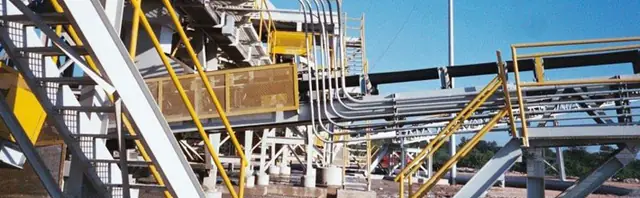
A typical quarry's electrical footprint includes crushers, which pull heavy inrush current every time they start under load, conveyors running long stretches of exposed conduit across the site, feeder motors, sump pumps that run more or less continuously to keep the pit dry, generators, fueling tank equipment, motor control centers, and the outdoor lighting that keeps a night shift running safely.
Each of those has a different failure pattern. A crusher's starter takes the hardest cycling from repeated high-inrush starts. Conveyor conduit takes the most physical abuse, exposed to weather and constant rock dust for years at a stretch. Sump pumps fail quietly, because nobody notices a pump has stopped working until the pit is wetter than it should be.
What actually wears out on a working quarry
Vibration and moisture do most of the damage at a mine site. Conduit runs get abraded where they cross equipment that shakes constantly. Connections corrode faster in ground that is wet more often than it is dry. Junction boxes that were sealed properly at installation work themselves loose over a few thousand hours of a crusher running nearby.
None of that shows up as a dramatic failure right away. It shows up as a slightly higher resistance reading on this year's ground test than last year's, which is exactly the kind of thing the annual test is built to catch.
The site office is still part of the same inspection
A quarry's electrical scope does not stop at the crusher and the conveyor line. The scale house, the site trailer, and any office wiring on the property are part of the same operation, and the same standard of workmanship applies whether the panel in question is feeding a feeder motor out on the pit floor or a light switch in the dispatch office. Serious mining equipment being powered as often as it is gas powered cuts both ways: the heavy line work gets the attention it needs, but the ordinary wiring around it does not get treated as an afterthought either.
Certified, and on call
We have held MSHA #UJT and worked quarries and surface mines around Ardmore since 1991, alongside our residential, commercial, industrial and petrochemical work. If your mine is due for its annual ground test, or something on the crusher or conveyor line needs a look, call 580-226-4041. We are on call 24/7 for the sites in Carter, Marshall, Love, Johnston and Murray County that cannot wait for a Monday morning.
Quality Electric Construction and Maintenance Corp. — (580) 226-4041
Call (580) 226-4041More articles
What Actually Happens During a Panel Upgrade
Before a single wire moves, an electrician has already worked out what your house actually needs. Here is what the job looks like from start to finish.
Why an Intermittent Electrical Problem Takes Time to Find
An intermittent fault hides by definition. Here is what troubleshooting actually looks like, and why the diagnosis is the part worth paying for.